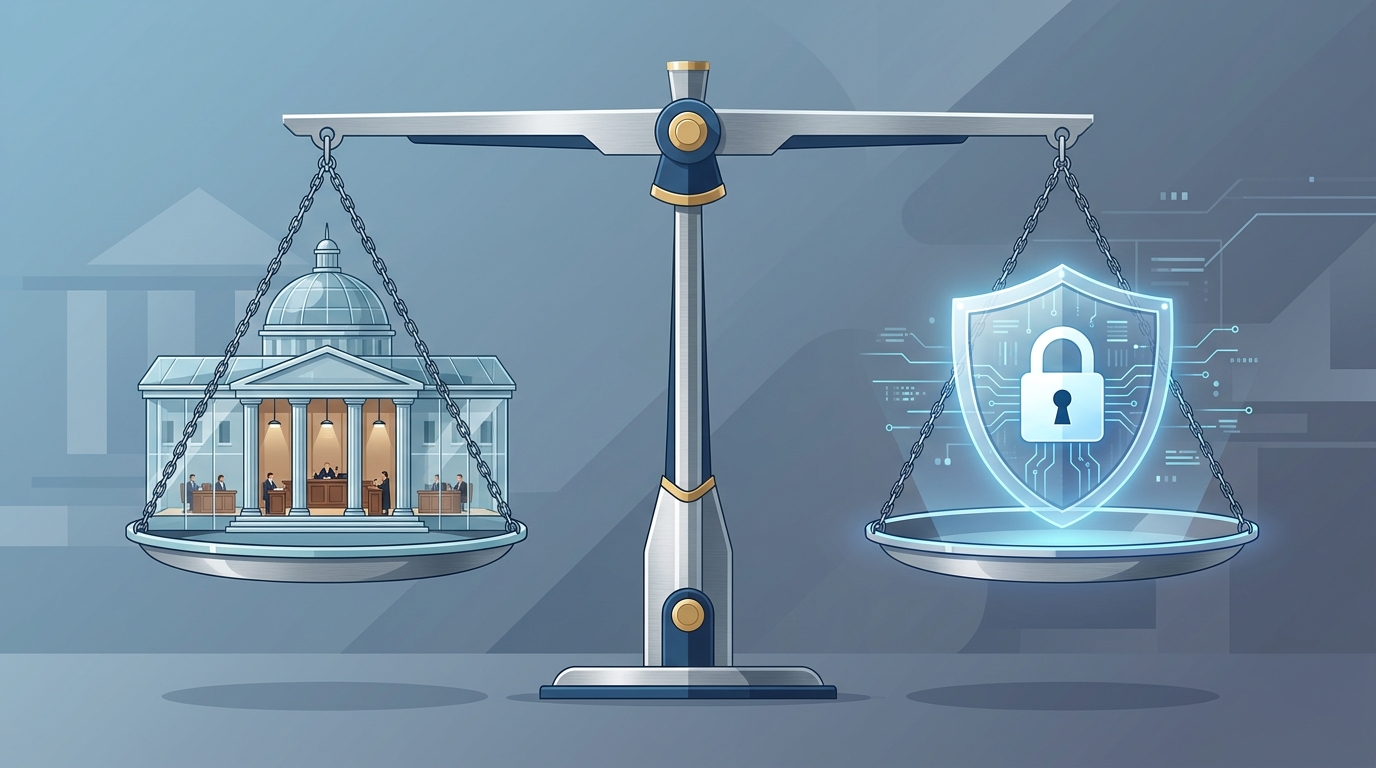
Public mugshot databases sit at the center of one of the most heated ethical debates in criminal justice today. The question of mugshot database ethics forces us to weigh two values Americans hold dear: government transparency and individual privacy. On one side, open access to arrest records serves as a check on law enforcement power. On the other, a booking photo published online can follow a person for decades — destroying job prospects, damaging relationships, and branding someone as guilty long before a jury ever convenes.
This article examines the ethical arguments on both sides, the real-world consequences backed by peer-reviewed research, and the growing wave of state and federal action reshaping how mugshots are published and accessed across the United States.
Why Mugshots Became Public Records in the First Place
The tradition of making arrest records publicly accessible dates back to the founding principle that government should operate in the open. The Freedom of Information Act (FOIA) at the federal level, and equivalent open-records laws in every state, were designed to prevent secret arrests, coerced confessions, and abuse of police power. When a government agency takes someone into custody, the public has a legitimate interest in knowing about it.
Historically, this transparency served a narrow audience. A mugshot might appear in a local newspaper or be viewed at a courthouse clerk's office. Access required effort, and the information faded from public memory over time. The internet changed that equation completely. What was once a brief mention in a police blotter became a permanent, searchable digital artifact — indexed by Google and replicated across dozens of websites within hours of an arrest.
The shift from analog to digital transformed mugshot access from a transparency mechanism into something its original architects never intended: an indefinite public record that follows individuals regardless of case outcome.
Are Public Mugshot Databases Ethical? The Core Tension
The ethical debate around public mugshot databases is not a simple binary. Reasonable people disagree because the stakes on both sides are genuinely high.
The Case for Transparency
Proponents of open mugshot access argue that sunlight is the best disinfectant. Public booking records help communities track local crime, hold law enforcement accountable for wrongful arrests, and allow victims to identify suspects. Some law enforcement agencies maintain that posting mugshots can prompt additional victims of serial offenders to come forward, strengthening cases that might otherwise go unsolved.
There is also a constitutional dimension. The First Amendment protects the right to access and republish government records. Courts have repeatedly held that arrest information, once released by a government agency, enters the public domain and can be freely disseminated by the press and private citizens alike.
The Case Against Unrestricted Access
Critics counter that unrestricted mugshot publication undermines a more fundamental right: the presumption of innocence. An arrest is an accusation, not a conviction. Yet a mugshot on the internet communicates guilt to anyone who encounters it — employers, landlords, romantic partners, neighbors. As journalist Matt Waite of the University of Nebraska-Lincoln described it, mugshots function as "a digital scarlet letter."
The Bail Project''s research underscores this point: the public sharing of mugshots undermines the presumption of innocence by branding individuals as criminals at the moment of arrest, before any evidence has been weighed in court.
The Real-World Harm of Online Arrest Records
The consequences of a publicly accessible mugshot extend far beyond embarrassment. Peer-reviewed research quantifies the damage in concrete terms.
Employment and Economic Impact
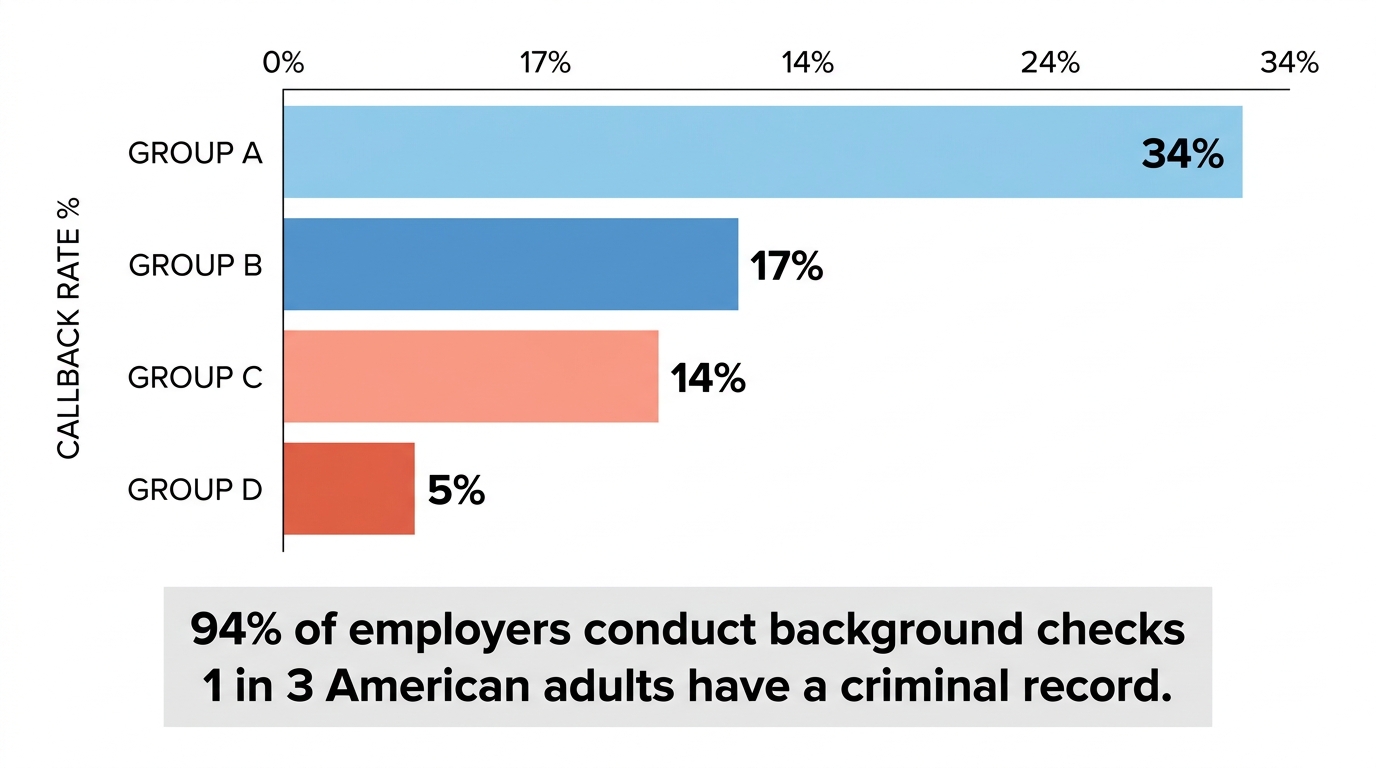
A landmark study by sociologist Devah Pager at Princeton University found that a criminal record reduces the likelihood of a job callback by nearly 50 percent. White applicants with a criminal record received callbacks 17% of the time compared to 34% without one. For Black applicants, the penalty was even steeper: a 5% callback rate with a record versus 14% without.
That research examined actual convictions, but the problem extends to arrests that never result in charges. An estimated 70 to 100 million Americans — roughly one in three adults — have some form of criminal record, according to the Brennan Center for Justice. Many of those records reflect arrests where charges were dropped, dismissed, or never filed. Yet the mugshot remains online, and approximately 94% of employers conduct criminal background checks, according to a Professional Background Screening Association survey.
The collision of permanent online mugshots and near-universal background screening creates a system where an arrest alone — without any finding of guilt — can derail a career.
Racial Disparities Are Amplified
Pager''s research revealed a particularly disturbing finding: Black applicants without any criminal record received fewer callbacks than white applicants who had one. When a criminal record is added to existing racial bias, the compounding effect is devastating. The criminal record penalty for Black applicants (60% reduction) was roughly double that of white applicants (30% reduction).
Mugshot galleries amplify this disparity. As Poynter has documented, routine publication of mugshots can reinforce the false perception that people of color disproportionately commit crimes, creating a feedback loop between media representation and public bias.
Housing, Relationships, and Mental Health
The damage is not limited to employment. Landlords screen tenants. Banks review applicants. A mugshot surfacing in a background check or a casual Google search can result in denied housing applications, rejected loan requests, and fractured personal relationships. For the individual, the psychological toll of permanent public association with an arrest — even one that led nowhere — can be severe. As the Center for Digital Ethics and Policy noted, "once it''s out there, it''s almost impossible to repair and restore" a damaged online reputation.
The Mugshot Removal Industry: Exploitation Built on Exploitation
The ethical problems with mugshot databases spawned a secondary industry that is arguably even more troubling. Commercial mugshot websites scrape booking photos from government sources and republish them on private websites, then charge individuals hundreds or thousands of dollars to remove their own images.
Removal fees typically range from $200 to $600 per website, with total removal costs across multiple sites reaching $1,000 to $2,500 or more. In many documented cases, the same entity owns both the publishing site and the removal service — a business model the American Bar Association called an "online extortion scheme" in 2018.
This pay-to-remove model creates a two-tiered system where those who can afford removal fees escape the stigma of a public mugshot while those who cannot — disproportionately low-income individuals and communities of color — remain permanently branded. The ethical failure here is compounded: a public record meant to ensure government accountability becomes a tool for private profit at the expense of the most vulnerable.
Google responded to the problem by releasing a dedicated algorithm update targeting mugshot websites, devaluing exploitative sites in search results and classifying pay-for-removal practices as "exploitative removal practices" eligible for deindexing. While this reduced the visibility of the worst offenders, it did not eliminate the underlying problem.
Should Mugshots Be Public? What the Law Says Now
The legal landscape governing mugshot publication is shifting rapidly, and the trend is unmistakably toward greater restriction.
State-Level Legislation
At least 18 states have enacted laws restricting mugshot publication or regulating mugshot removal websites as of 2025. Key examples include:
- New York (2019) — Banned the release of mugshots under the state''s Freedom of Information Law unless there is a specific law enforcement purpose.
- California — SB 393 prohibits law enforcement from posting mugshots for nonviolent crimes absent a public safety threat. Assembly Bill 1475 bars police from posting mugshots on social media entirely.
- Utah — Prohibited publishing mugshots until after conviction.
- Colorado — SB20-100 bans releasing mugshots unless a demonstrable public safety risk exists.
- Georgia — Requires mugshot websites to remove images within 30 days of a takedown request or face civil penalties.
- New Jersey — Exempts mugshots of non-convicted individuals from the state''s open public records law.
Additionally, 14 states have specifically prohibited commercial websites from charging fees to remove mugshots, targeting the exploitative business model directly.
The Landmark 9th Circuit Ruling
In September 2024, the U.S. Court of Appeals for the 9th Circuit issued what may become the most consequential mugshot ruling in American history. In a unanimous decision, the three-judge panel ruled that the Maricopa County Sheriff''s Office practice of posting arrestees'' mugshots online constitutes unconstitutional pretrial punishment.
Judge Marsha Berzon wrote that the county''s sole justification — transparency — was insufficient to outweigh the punitive effect of publishing booking photos and personal information before any finding of guilt. The case originated when Brian Houston''s mugshot and personal details appeared on the sheriff''s website after an assault arrest. His charges were later dismissed, but his mugshot had already been scraped by commercial databases. The lawsuit noted that Mugshots.com alone had published booking photos of close to one million Arizona residents, with 834,000 from Maricopa County.
This ruling — if upheld and adopted by other circuits — could fundamentally reshape how government agencies handle mugshot publication nationwide.
Federal Developments
At the federal level, the U.S. Department of Justice revised its policy in 2016 to restrict public release of federal mugshots, citing privacy concerns and potential harm to due process. While there is no comprehensive federal mugshot law, the American Privacy Rights Act introduced in 2024 would expand individual control over personal data, including arrest records held by private companies.
How News Organizations Are Rethinking Mugshot Publication
The ethical reckoning is not limited to legislatures and courts. Major newsrooms are voluntarily changing their practices.
A Columbia Journalism Review investigation found that mugshot galleries were once treated as "game-changers" for web traffic — cheap to produce and reliable click magnets. A 2016 Fusion study found 40% of the 74 newspapers surveyed published mugshot galleries.
That calculus is changing. Organizations including Gannett, the Associated Press, and the Chicago Tribune have adopted policies discouraging or prohibiting routine mugshot publication, particularly for minor offenses. Cleveland.com implemented a "right to be forgotten" policy allowing individuals to request removal of mugshots for minor crimes. As the site''s editor Chris Quinn stated: "I can''t use tradition to wreck people''s lives."
Media ethics specialists now recommend that any newsroom publishing mugshots should: contextualize the image for readers, articulate the specific public-service value, and follow up on every case to report dispositions — not just arrests. Few newsrooms have the resources to meet all three criteria, which is itself an argument for restraint.
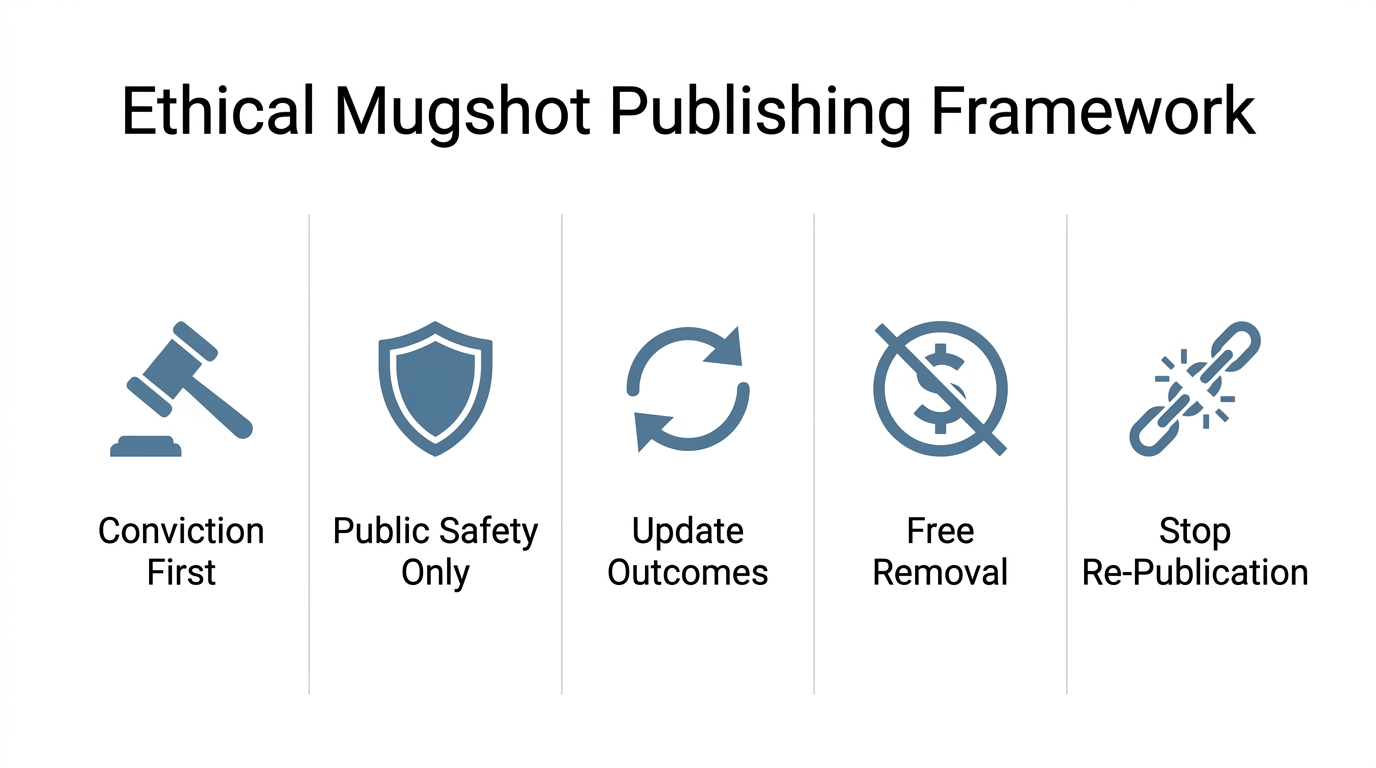
Ethical Mugshot Publishing: A Framework for Responsibility
The debate does not have to end in an all-or-nothing conclusion. It is possible to maintain public access to arrest information while minimizing unnecessary harm. The following principles represent an ethical framework that balances transparency with individual rights. To understand more about how this balance plays out in practice, read our analysis of freedom of information versus the right to privacy.
Principle 1: Tie Publication to Conviction, Not Arrest
The strongest ethical case for publishing a mugshot exists after a conviction, when guilt has been established through due process. Publishing at the point of arrest — before any evidence has been tested — treats the accused as guilty by default.
Principle 2: Limit Scope to Public Safety Needs
Mugshots of individuals who pose an active threat to public safety (fugitives, violent offenders at large) serve a clear purpose. Routine publication of every booking photo from every misdemeanor arrest does not meet that standard.
Principle 3: Mandate Disposition Updates
If a mugshot is published, the outcome of the case must be published with equal prominence. Dismissed charges, acquittals, and expungements should trigger automatic removal or prominent notation. Learn more about how these processes work in our guide to understanding expungement and record removal.
Principle 4: Prohibit Pay-to-Remove Models
No one should have to pay a private company to reclaim their reputation after charges are dropped. Ethical mugshot databases should offer free removal for non-convicted individuals and never monetize the removal process. For practical steps on addressing existing listings, see our resource on how to remove or update a mugshot online.
Principle 5: Prevent Re-Publication Loops
Even when a mugshot is removed from the original source, commercial scrapers may have already copied it. Ethical systems require mechanisms to propagate removal requests across downstream databases — a technical challenge, but an ethical necessity.
The Future of Mugshot Database Ethics
Several forces are converging to reshape how mugshot databases operate in the coming years.
Legislative momentum is accelerating. With 18+ states already restricting mugshot access and federal proposals advancing, the regulatory environment will continue tightening. The 9th Circuit''s pretrial punishment ruling could inspire similar challenges in other jurisdictions.
Technology creates new challenges. Facial recognition systems can match a person''s face to a mugshot database in seconds, extending the reach of arrest records far beyond a Google search. AI-powered background check tools may surface mugshot data in contexts the original publishers never anticipated. For a deeper examination of where this is heading, explore our article on the future of digital mugshot databases.
Public opinion is shifting. Growing awareness of mass incarceration, racial disparities in the justice system, and the lifelong consequences of criminal records has eroded public tolerance for systems that punish people before — or instead of — a trial. Platforms that publish mugshots responsibly, with clear ethical guidelines and a commitment to fairness, will distinguish themselves from those that do not.
The central question is not whether mugshot databases should exist. Public records serve a vital democratic function. The question is whether we can design systems that preserve transparency without sacrificing the rights of individuals who have not been found guilty of anything. The ethical answer requires treating every person in a mugshot as what they legally are at the point of arrest: innocent.
At America''s Top Mugshot, we believe that responsible platforms never shame or humiliate anyone. Understanding how digital reputation affects your future is the first step toward building a system that serves both the public interest and individual dignity.