

Your digital reputation is the impression people form about you based on what they find online. It includes social media profiles, news articles, professional listings, public records — and yes, mugshots. Whether you think about it or not, your online footprint is shaping how other people see you.
For someone whose mugshot appears in search engine results, the consequences can be immediate and lasting. A booking photo from years ago — even from an arrest that never led to a conviction — can show up when someone Googles your name. And in a world where employers, landlords, and even potential dates routinely search people online, that photo can quietly close doors you never knew were open.
This article breaks down how digital reputation works, why a mugshot in search results matters, and what practical steps you can take to manage your online presence.
What Digital Reputation Actually Means
Think of your digital reputation as your online first impression. When someone types your name into a search engine, the results that appear form a picture — accurate or not — of who you are.
For most people, search results include social media profiles, maybe a LinkedIn page, perhaps a mention in a local news article or a company directory. These results are generally neutral or positive. They paint a picture of a normal person going about their life.
But when a mugshot appears in those results, it can dominate everything else. Booking photos are visually striking — they stand out on a results page. A person searching your name might see your LinkedIn profile, your Facebook page, and right alongside them, a booking photo with your name, the word "arrested," and a list of charges. That single result can override every other impression.
The problem is compounded by the fact that mugshots are public records, which means search engines index them readily. A mugshot listing can rank high in search results for years, long after the underlying case has been resolved.
Who Is Searching for You — and Why It Matters
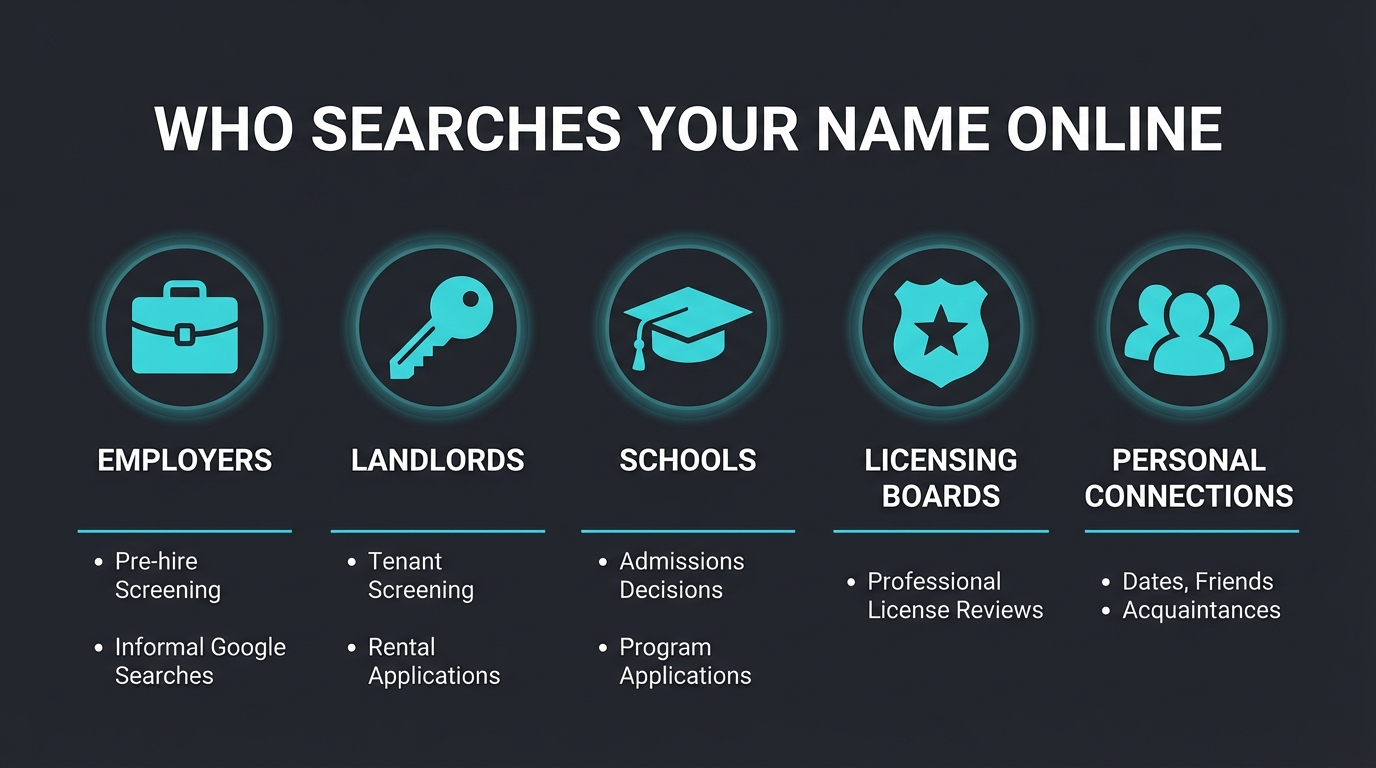
The people most likely to search your name online are often the people whose opinions have the biggest impact on your life.
Employers
It is common practice for hiring managers to search a candidate's name online before making an offer. Sometimes this happens formally as part of a background check process. Other times, it is as informal as typing a name into Google between interviews. Either way, what appears in search results can influence hiring decisions.
A mugshot appearing in search results is not the same as a formal criminal background check — and the legal rules around each are different. Formal background checks conducted by third-party agencies are regulated by the Fair Credit Reporting Act (FCRA), which requires consent, accuracy, and gives people the right to dispute incorrect information. A casual Google search has no such protections.
This means that even if your formal background check comes back clean — because charges were dropped, the record was expunged, or you were never convicted — a mugshot sitting in Google results can still create doubt in a hiring manager's mind. They may never mention it. They may not even be fully aware of how it influenced their decision. But the impression is there.
Landlords
If you have ever applied to rent an apartment, you know that landlords screen tenants. Many conduct formal background checks, but many also do their own online searching. A mugshot in search results can affect your ability to secure housing, even if the arrest never resulted in a conviction.
Schools and Professional Licensing Boards
College admissions offices, graduate school programs, and professional licensing boards may search applicants online. For fields that require professional licenses — nursing, teaching, law, real estate — a mugshot in search results can raise questions during the licensing process, even when the applicant has no conviction on their record.
Personal Relationships
It is not just institutions that search your name. Friends, dates, neighbors, and acquaintances do it too. A mugshot appearing when someone casually Googles you can affect personal relationships and social standing in ways that are hard to measure but very real.
The Problem of Permanence
One of the most frustrating aspects of a mugshot appearing online is how long it can persist. The justice system may move on — charges dropped, case dismissed, record expunged — but the internet often does not.
A mugshot published on a website gets indexed by search engines. Other sites may scrape and republish it. Cached versions persist even after the original is removed. The result is that a single arrest from years ago can leave a digital trail that takes significant effort to clean up.
This permanence is especially harsh because it does not reflect how the justice system actually works. The system has built-in processes for resolution — dismissals, acquittals, expungements, sealed records. These processes exist because society recognizes that people deserve the chance to move forward. But when a mugshot lives on indefinitely in search results, it effectively overrides those processes.
Steps You Can Take to Manage Your Digital Reputation
If a mugshot is affecting your search results, you are not powerless. There are practical steps you can take, and many of them are free.
1. Request Removal from Sites That Allow It
Start with the sites where your mugshot appears. Many platforms — including ours — offer a removal process. On America's Top Mugshot, removal is always free. You can submit a request through our contact form or email us at info@americastopmugshot.com. We review requests within 24 to 48 business hours and never charge a fee.
For a detailed walkthrough of our removal process, read our guide on how to remove or update a mugshot online.
Other sites have their own processes. Look for "Removal" or "Contact" links, usually in the website footer. Be aware that some sites charge fees for removal — a practice we strongly disagree with. If a site demands payment, note that several states have laws restricting pay-to-remove practices, and the site may be violating them.
2. Use Google's Outdated Content Removal Tool
If a mugshot page has been taken down from a website but still appears in Google search results, you can ask Google to remove the outdated result. Google offers an outdated content removal tool specifically for this purpose. It does not remove content from websites — it only removes the cached search result after the original page is already gone.
Google has also expanded its policies around removing certain types of personal information from search results. If a mugshot page contains your personal information and meets Google's criteria for removal, you may be able to request that it be de-indexed even if the page still exists.
3. Build a Positive Online Presence
One of the most effective long-term strategies is to create positive content that pushes negative results further down in search rankings. Search engines prioritize recent, relevant, authoritative content. By building your own online presence, you can influence what appears when someone searches your name.
Practical steps include:
- Create or update a LinkedIn profile. LinkedIn profiles tend to rank high in search results for a person's name.
- Set up profiles on professional networks relevant to your field.
- Start a personal website or blog using your full name as the domain if possible.
- Engage on social media with public profiles that reflect who you are today.
- Contribute to community organizations that may list your name on their websites.
The goal is not to hide the past — it is to make sure the present and future are better represented in search results.
4. Consider Legal Help for Stubborn Sites
If you have had your record expunged or sealed and websites are refusing to remove your mugshot, an attorney may be able to help. Lawyers who specialize in internet privacy or online reputation can send legal demand letters, and in some cases, pursue legal action against non-compliant sites.
Many attorneys in this area offer free initial consultations, so it is worth exploring your options if informal removal requests have not worked. For more on how legal remedies work, see our article on understanding expungement and record removal.
How Our Platform Approaches This Responsibly
We are aware that publishing mugshots carries real consequences for the people in our listings. That awareness shapes how we operate.
- Free removal, always. We never charge to remove or update a listing. If you have grounds for removal — expungement, dismissal, inaccuracy, or any other legitimate reason — the process is free.
- Correction requests welcome. If information in a listing is wrong, tell us and we will fix it.
- Presumption of innocence. Our disclaimer clearly states that everyone featured on the platform is presumed innocent unless and until proven guilty. An arrest is not a conviction.
- Not a consumer reporting agency. Our platform is not a background check service and should not be used as one. We publish public records for general informational purposes, not for making employment, housing, or credit decisions.
We believe platforms that publish public records have a responsibility to make removal accessible and free. For more on our ethical approach, read the ethics of public mugshot databases.
The Broader Conversation About Second Chances
There is a growing recognition that the permanence of online information conflicts with the values of rehabilitation and second chances that the justice system is supposed to support.
When someone serves their sentence, completes probation, finishes a diversion program, or has their record expunged, the system is saying: this person has fulfilled their obligation and deserves a fresh start. But if a mugshot continues to appear in search results indefinitely, that fresh start becomes much harder to achieve.
More states are considering legislation that addresses this tension — laws that require mugshot sites to honor expungement orders, laws that restrict pay-to-remove business models, and laws that give individuals more control over their digital footprint after their case is resolved.
This is not just a legal issue or a technology issue. It is a question about what kind of society we want to be. Do we believe in second chances? If so, the systems we build — including digital platforms — should reflect that belief.
What You Can Do Right Now
If a mugshot is affecting your digital reputation, do not wait. Take action today:
- Search your own name. Find out exactly what appears and on which sites.
- Submit removal requests to every site that offers them. Start with us — it is free.
- Use Google's tools to clean up outdated cached results.
- Start building positive content that represents who you are now.
- Talk to a lawyer if sites are not cooperating and you have legal grounds for removal.
Your past does not have to define your digital future. There are tools and processes available to help you take control of your online presence, and platforms like ours that are committed to making that process fair and free.
If you need help with a listing on our platform, contact us or email info@americastopmugshot.com. We are here to help.